

Moles Upset the Cards
After 2 convincing victories over the Sands in week 1 of the exhibition games, the Wildcards came into Mareotis the undefeated favourites in their matchup with the 1 and 1 Moles. However, the Wildcard’s dominance last week became a distant memory as the Moles upset the Wildcards 4–2 with a balance of relentless offence and sound defence.
Minas 28, 2078, m249

After 2 convincing victories over the Sands in week 1 of the exhibition games, the Wildcards came into Mareotis the undefeated favourites in their matchup with the 1 and 1 Moles. However, the Wildcard’s dominance last week became a distant memory as the Moles upset the Wildcards 4–2 with a balance of relentless offence and sound defence.

The Moles opened up the match with a flurry of offensive scoring chances which finally broke the Wildcards at just under four minutes of play.
The Moles’, Kara Okeke created a turnover at center-ice and delivered a beautiful cross-ice to a streaking Captain, Janice Campbell—allowing her to break in and blast a shot over the glove of Wildcard goalie, Jules Arquette.
“Kara knows where I like to go since we used to play recreational field hockey before ISMO,” said Campbell. “With all this open space, I was able to get free and she fed it perfectly to my sweet spot where I was able to open the scoring.”
The on-ice chemistry of Campbell, Okeke, and Laura Hall (all friends from San Olympus) is quickly silencing early critics of the Moles for having too many female players.
After Campbell won the opening faceoff back to Hall, Hall was able to rush up-ice drawing the attention of two defending players who got crossed up, allowing Hall to drop the puck to a freed up Bryan Taylor.
With Campbell taking out the other Wildcards player with a well-timed check, Taylor was able to use his speed to get to the open and fire a wrist shot past Arquette’s glove side to score a second goal for the Moles.
Wildcards Rally
The Wildcards would finally respond with an unique goal at 6:28 that took advantage of the circular ramps encircling the rink. To avoid Okeke’s defense, the Wildcards’ Tia Halvorsen skated up the ramp past center ice and just before the Moles’ blue line to deliver an odd angle shot mid-way up the pike. This caught the Moles’ goalie off-guard for the Wildcards’ first goal of the game.
“To be honest, I lost sight of the puck for a brief moment as Tia went up and before I knew it, the puck came past me at such a strange angle”, said Moles’ Goalie, Sam Bailey. “I guess that’s something new to work on in practice.”
The Moles responded to the goal by aggressively taking control of the puck. Utilizing a series of crisp passes which allowed Taylor to score his second goal of the game to give the Moles a 3 -1 lead.
In the aggressive protection of their lead, the Moles inevitably incurred four straight penalties which dominated the 2nd period of play as Vicky Li, Laura Hall and Fredrick Mattila (twice) each spent time in the box. Yet each time, the Moles’ were able to use their superior passing and puck control to mitigate each penalty.
Third Period: The Final Countdown
With the ugliness of the 2nd period over, the 3rd period opened with a beautiful pass from behind the net from Laura Hall to Fredrick Mattila who slapped it through the five-hole for the 4th goal of the game.
The Wildcards were able to squeeze in another goal with Martinez tipping a shot from the side of the net from Harris with 6 minutes left in play, but were ultimately unable to close the gap.
The buzzer sounded with Moles 4 and Wildcards 2.
“This was a really good confidence booster for us”, said Campbell. ”All of our forwards were able to put the puck in the net. We made some stupid mistakes in the second, but our defencemen and Sam (Bailey) shut down their powerplay opportunities.”
The Wildcards will look to regroup against the Phantoms in Week 3 at Mareotis while the Moles will take on the Sands at Noviymir.

The Game I Thought I Knew
The Phantoms played against Khimik at Korolev's K-Rink and I was going to give this new ISMO version of the game a chance. I always enjoyed the 3-on-3 element of hockey and with “Bigger rinks!” they promised, sounded compelling. With dramatically different physics and amateur players, however, I had reservations.
Mina 28, 2078, m249

Even though hockey has, like most sports, diminished from its hey-days, I grew up in a hockey family back on Earth. I played in a junior league before college until an injury started to steer me away from the game. I was sure I severed all tied with it with when I decided to move to Mars, to a planet with no sports at all. Yet, here we are.
Most of the young Martians I know have never heard of the game until now, not basic exposure via an Earth feed or game title. They know little to nothing of the legendary superstars or the speed and physicality of the sport. It was fast, furious, and heavy hitting.
Today, was my return to a game I thought I knew.
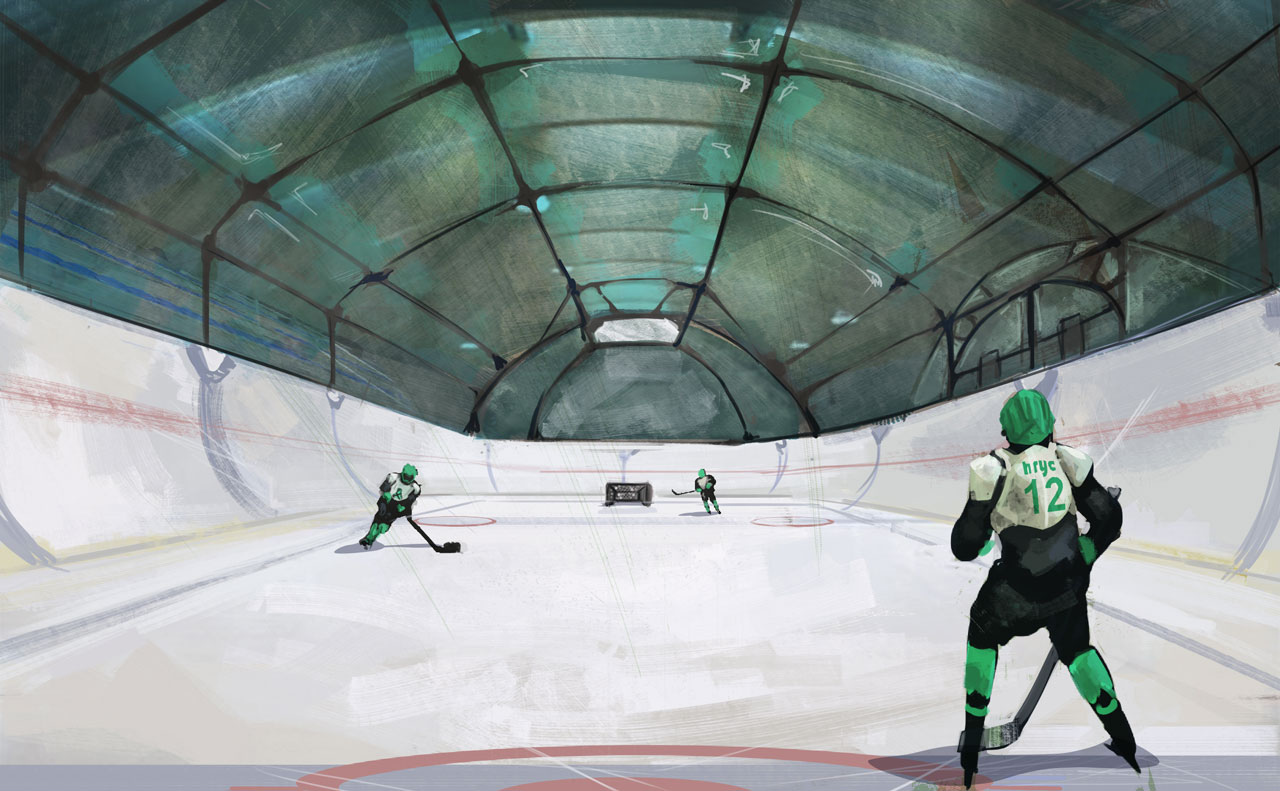
Khimik takes to the ice. The team was named after the Chemical Engineers that first starting recreational ice skating on the frozen water deposits north of Korolev.
The Phantoms played against Khimik at Korolev's K-Rink and I was going to give this new ISMO version a chance. I always enjoyed the 3-on-3 element of hockey and with “Bigger rinks!” they promised, sounded convincing. With dramatically different physics and amateur players, however, I had reservations.
As I sat with 250 other curious attendees in the small seating area around the rink, everyone I talked to, agreed: "This is not your dad’s hockey."
You would expect switching from Aero Football to the pace of hockey to be overwhelming, but even comparing it to tradition hockey, beyond the obvious differences with the rink, the key difference was the pacing.
I was amazed at how little stoppage there was. The circular ramps kept the puck in play and it was amusing (if not funny) to see the players attempt to navigate it. There were few penalties and rough-housing, but when players were sent to the penalty box, the effect of going one player down was massive.
At the start, it was back and forth action as teams traded chances off the rush. Before, finally, a goal! Khimik took the lead 7:51 in the first period.

Khimik forward Ruslan Vasiliev evades Phantom defender Alex-Gaumond.
With these compact teams, players were forced to take on multiple roles throughout the game. They morphed and evolved through the game as the captains, Jonathan Moore (Phantoms) and Alex Yanovna (Khimik) got creative. The Phantoms used all three of their 3 forwards late in the game on a power play while Khimik responded with 2 defenders to kill the penalty.
This all made for an amazing flow of action throughout the game.
As the players flew by, so did the time. With 15 minute periods, before I knew it, the game was over and Khimik hung on to narrowly escape a Phantoms come-back, and win the game 3 to 2.
I was pleasantly surprised by today's match. This kind of hockey builds on familiar roots while introducing appropriate derivations that for Martian conditions and tastes. Putting my fondness of the sport aside, ISMO has been transparent about the experimental nature of sport, so if you come into a game with an open mind and with the right expectations with respect to the players' skill level, there is a lot to enjoy.
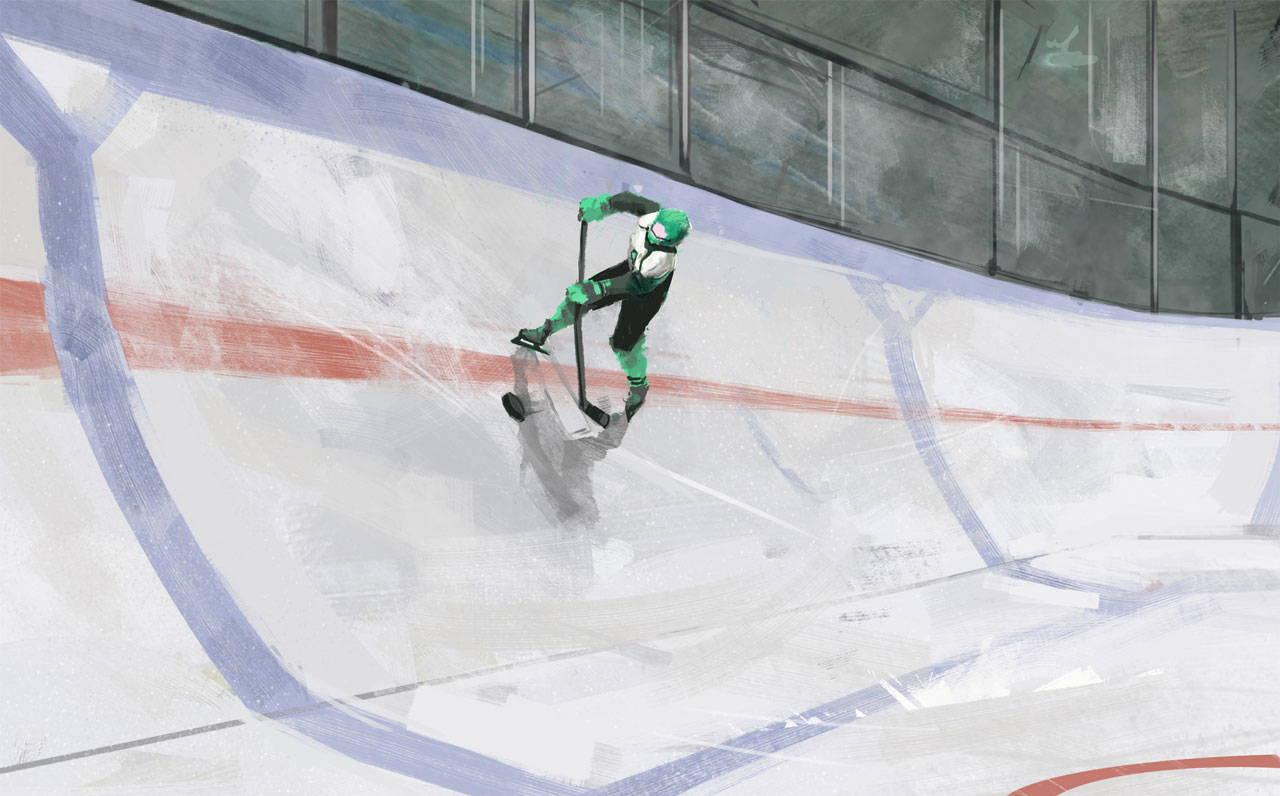
Ruslan Vasiliev is the lead scorer for Khimik adds 1 more goal bringing his total to 4 in the last 3 games.

Tales From the Pitch: Hockey Edition
I got a chance to check out out the first Phantoms versus Cosmonauts game, and the rumours are exaggerated. But not by much. There wasn’t much grace or style to the game. It was sloppy, it was at times brutal, and once it was borderline embarrassing. But don’t judge the sport just yet.
Aries 2, 2078m m249

Ice, Ice, Babies.
I know, I know, there’s no pitch in hockey. Well it’s my column and I’ll keep the name that has garnered me legions of adoring fans. I also get to start off this column by relaying huge news: football isn’t the only sport on Mars anymore. Ice hockey is here.
When we first heard rumours of a football league on Mars, it sounded like a crazy flight of fancy, but it turned out to be the most exciting sporting event on two planets. So I had wanted to keep an open mind when I first heard about a group of engineers and miners had come up with the idea of bringing ice hockey to the Red Planet. But I did keep hearing rumours that no one knew how to skate, which, historians tell me, is a key component of playing ice hockey.
I got a chance to check out out my first game this weekend, and the rumours are exaggerated. But not by much. There wasn’t much grace or style to the game. It was sloppy, it was at times brutal, and once it was borderline embarrassing. But don’t judge the sport just yet.
The matches are held on a surface covered in ice, which continues up a curved area surrounding the rink. The theory is that a fast-paced game would allow for players to skate across the ice and up the sides to weave around their opponents, but mostly I just saw a lot of athletes crashing into each other. There were moments where it was like watching toddlers play.
Now the setup is impressive. Atmosphere is pumped into the enclosed arena, so no EV suits are required for players and spectators enjoy a more intimate experience compared with viewing from Spectator Transports.
The players have different equipment depending on their positions and though the razor sharp blades seem precarious, they are programmed with a safety feature that causes them to retract before impact. It will allow players to keep all of their fingers and toes while on the ice.
The exhibition games are to test the viability of the sport, the workability of the rules, and the interest level of the fans.
I mention all of this because I think this sport needs to be given a chance. We’ve been spoiled by the success of MAFL and now we are expecting any other sport that comes our way to operate at the same level but within a fraction of the time. That isn’t fair to the hardworking men and women that are trying to create something new. MAFL had its rougher moments as well, but we tend to forget those occurrences now that the league is a huge success. Martian Ice Hockey has a lot of kinks to work out, but I saw a diamond in the rough out there today. All the components are there for an amazing sporting experience. We just need to give them a chance.

ISMO Hockey Roundup
The first weekend of ISMO Hockey demonstrates how immature the sport really is. With a blend of highlights, lowlights and everything in between, ice hockey is likely to entertain, but not necessarily for the reasons ISMO had hoped for.
Mina 22, 2078, m249

Fredrick Mattila, of the Moles.
ISMO concluded their first ambitious weekend of ice hockey in the 3 Northern settlements. With each matchup a 'double header' seeing the paired teams repeat play on Saturni and Solis, the games delivered a taste for the new sport.
The small seating capacity at the prototype rinks ensured a sell-out crowd for the opening weekend. Largely reserved for media, partners friends, and family, the audiences were enthusiastic and generally encouraging toward the amateur players.
Mareotis
The Cosmonauts delivered a convincing win over the Phantoms in game 1 at Mareotis. Despite outshooting the Cosmonauts 30 to 20, the Phantoms were only able to beat goaltender Marius Hansen once after a wild scramble in front of the net allowing #75 Peter Lehmann to sneak the puck past him.
Otherwise, the game was almost entirely carried on the shoulders of Anna Fedin, captain of the Cosmonauts, who netted a hat-trick and an assist. Vitalia Burian also scored late in the 3rd period to make it a 4-1 game.
Early in game 2, it looked as though the Cosmonauts would repeat the prior day's victory. Goals by Anna Fedin and Yaro Novak allowed them to take an early lead.
The Phantoms held the Cosmonauts off during the 2nd period and closed the gap to 1 after a point shot by Jonathan Moore beat Hansen.
Phantom defenceman Alex Gaumond got the equalizer in the 1st minute of the 3rd period.
The go-ahead goal came after Peter Lehmann was fed on the wing by Gaumond and snapping a powerful shot Hansen's open side.
Lehmann would add an insurance goal 6 minutes later, ending the game 4-2.
"It was a great start," said Anna Fedin who had a total of 4 goals over the two games, "It is an entirely different game compared with practise games. We would have liked to sweep the series, but we are not disappointed in our performance as a team."
Noviymir
It was a sleepy start in Noviymir as the Moles and Khimik fumbled for much of game 1. In fact, both teams looked rather scared at the onset. There were long stretches of slow, aimless passing mixed in with other cringe-worthy moments.
The first goal by Ruslan Vasiliev in the 2nd period wasn't pretty. He fanned his shot, slipped, fell, and yet somehow unintentionally got the puck passed Moles goaltender Sam Bailey.
The following goal by defenceman Andrej Petrovyh was more convincing. A wrist shot up as Bailey went down gave Khimik a 2-0 lead.
The Moles would eventually get one back in the final minutes of the 2nd period, ending the match with a 2-1 score.
Fortunately for the spectators, the pace of game 2 did not resemble the awkward and sluggish play of the opening game.
According to Janice Campbell, captain of the Moles, "We psyched ourselves out and, as as result, it wasn't the game we wanted to play. Today, we promised to play for ourselves and it made a huge difference."
Through much of the game, the Moles were in lock-step with Khimik. Fredrick Mattila would counter goals by Alex Yanovna and Ruslan Vasiliev to earn a hat-trick and end regular time at 3-3.
It would be Campbell to score 6 minutes into overtime for the Moles win 4-3.
Korolev
Unlike the Noviymir games, the Sands were heavily outmatched against the Wildcards as they played at the K-rink. Mateo Martinez singled handed scored 11 goals, 7 on Saturni and 4 more on Solis.
"We were obviously outclassed by the Wildcards," said Sands captain, Mitchell Cruz, "I think we are all new at this, so we'll take this as a learning experience and come back harder next week.
After this weekend's display, the Sands have an obvious skill deficit. The 5 week round-robin schedule is unlikely to provide the adequate time to further development of skills or team chemistry, so the Sands may endure further humiliation before the exhibition series is complete.
Next Week
Starting next weekend, teams will play just one match a piece.
Moles will face the Wildcards in Mareotis; Sands will visit Noviymir to take on the Cosmonauts; and the Phantoms will make the trek to tackle Khimik.

Wildcards Dust-off the Sands
This was a double-header weekend for the ISMO debuted Martian Ice Hockey in Korolev, Noviymir and Mareotis. The Korolev series featured The Sands versus the Wildcards, playing back-to-back on both Saturni and Solis. The small spectator capacity at K-Rink was sold out with more than 250 curious attendees from across the colonies in attendance.
Mina 22, 2078, m249

This was a double-header weekend for the ISMO debuted Martian Ice Hockey in Korolev, Noviymir and Mareotis. The Korolev series featured The Sands versus the Wildcards, playing back-to-back on both Saturni and Solis. The small spectator capacity at K-Rink was sold out with more than 250 curious attendees from across the colonies in attendance.
Game 1
The Saturni game was a showcase of dominance by the Wildcards. The first goal came at 2 minutes and 30 seconds into the first period by Wildcards forward, Samuel Marquez, who fired a shot through the legs of Sands goaltender, Priya Christensen.
Before the end of the first 15 minute period, Carl Lindberg extended the Wildcards lead to 2-0 after a intercepting the puck from Sand's captain, Mitchell Cruz.
By the 2nd period, Sands seemed to lose composure and Mateo Martinez stole the show. Martinez, scored 5 consecutive goals against the Christensen who received little defensive support from her teammates.
In the 3rd, the Sands tightened their defences, but not enough to stop Martinez from netting his 6th and 7th goal before the end buzzer.
Of game 1, Martinez said, "We're very confident. Based on our practise games against Mareotis based teams, we know there is huge range in skill and competency, but having not played against the teams from the other home rinks, we just wanted to come out strong. We are, I am, very happy with the results."
Jules Arquette earned her first shutout stopping 12 shots from the Sands. Christensen faced 26 shots in the 9-0 loss.
Game 2
On day 2, the Sands had hoped to forget Saturni's game. They came out aggressive in the first half of the period and were able to draw first blood. Forward Jared Foster snuck around Wildcard defender, AmeliaHarris, by arcing around the ramp. His first shot was blocked by Arquette, but was able to quickly flip the rebound under her pads.
The Sands, however, were not able to hold the lead long. Carl Linberg responded with 2 goals before end of period taking the wind out of the Sands offense.
Martinez made a repeat of his game 1 performance with a hat trick over the course of the 2nd period.
Jesse Andersen would get another goal on the board for the Sands in the 3rd, but Martinez would get the final word in the game. With 7 minutes remaining, Amelia Harris made a beautiful pass for Martinez to tip passed Christensen.
Wildcards win the game 6-2 and sweep the Sands on their home rink.
Over the two games, the Sands were clearly outplayed. They made a combined 24 shots on goal compared with 46 by the Wildcards.
"We were outplayed on both days by the Wildcards," said #28 Mitchell Cruz, Captain of the Sands, "When Carl (Lindberg) got that shorthanded goal in the first, we lost our momentum. We are just going to keep at it and do our best in our next game against the Cosmonauts."

Moles Visit San Olympus
The hockey teams of ISMO started a promotional tour this week. With media events planned in every major colony, this is the first intimate exposure of winter-style sports on Mars.
Mina 15, 2078, m249

Janice Campbell, Captain of the Moles.
The hockey teams of ISMO started a promotional tour this week. With media events planned in every major colony, this is the first intimate exposure of winter-style sports on Mars.
The event in San Olympus was hosted by the 7 players of the Moles and attracted more than 60 attendees. The curiosity was, in part, fuelled by the fact that 3 of the Mole players are local residents. Though based in Noviymir, the Moles are entirely comprised of outside talent.
Attendees included media and invited members from the public. They were treated to a deep immersion experience of Martian Ice Hockey as well as a holographic sneak peeks of half a dozen other sports that are currently under development at ISMO.
Janice Campbell, a San Olympus resident and captain of the Moles, explained the set up, "There are two teams based out of Noviymir that will be playing in the exhibition games, but ISMO actually has created 5 teams in each of the hosting settlements, so we all share the same respective rinks and resources."
ISMO hockey is a mixed gender sport. The Moles are the only team in the exhibition that feature more female players than men, not unlike the Titans squad of Aero Football fame. Similarly, the team is already experiencing ridicule by their competitors, driving up the pressure for the Moles. If the MAFL is any indication, Campbell's team could have an advantage in a game that may favour the nimble, especially under Martian conditions. Unlike Earth variations of the game, boards are replace with circular ramps that dramatically change contact points.
When asked how the team was assembled, Campbell explained, "When ISMO began recruiting for players, 6 of us who regularly played recreational field hockey decided to apply together. We all got in, but only 3 of us (Laura Hall, Kara Okeke, and I) were able to get the extended leave from work to stick with the program. We easily could have been split up into different teams, but they kept us together, which is a big advantage for us. We've been able to build on that team chemistry and aim to leverage that."
All of the teams are comprised of only 7 players. 1 goaltender and typically an even split of forwards and defensemen. Only 3 players per team, in addition to the net minder, are allowed to play at any given time, but teams can rotate players and lineups at their own discretion.
As a non-professional organization, the teams are lean and do not have coaching or support staff, making the role of captain that much more critical.
"We have closed channel communication systems, so it isn't difficult to coordinate changes," said Campbell, "But it does get hard keeping track of what's happening. We have to be very disciplined or the chatter becomes disruptive, especially late in a game when everyone gets tired."
Games are broken down in to 3 fifteen minute periods. Infractions are penalized by taking an offender or substitute off the ice for 1 or 2 minute intervals. In the case of a second penalty, the opposing team is allowed an extra player on the ice.
When asked how the sport compares with Earth-style ice hockey Campbell responded, "I've never played ice hockey on Earth before, but we've studied both historical and modern forms of the game." After a pause to collect her thoughts, she added, "But if I have to compare, I think the guys at ISMO have cooked up something distinctively Martian. I can guarantee you that the generations of players that come after us will make this into a legendary game."

Ice Sports Exhibition Games Announced
Ice Sports of Mars announces the pilot teams and upcoming schedule of games to be held in Noviymir, Korolev and Mareotis. Martian-style hockey is about to become a reality.
Mina 8, 2089, m249
No matter how you look at it, our planet Mars is a cold, cold place.
Though temperatures at our equator can reach 20ºC during the summer, this tends to be more of an inconvenience than a reward for the colonies that have to manage the extreme fluctuations between day and night.
Rarely have we celebrated the frigid reality of the world we call home, until now.
After months of previews and sporadic reports, ISMO has officially announced the 6 teams that will be participating in the first ever Martian Ice Hockey exhibition games.
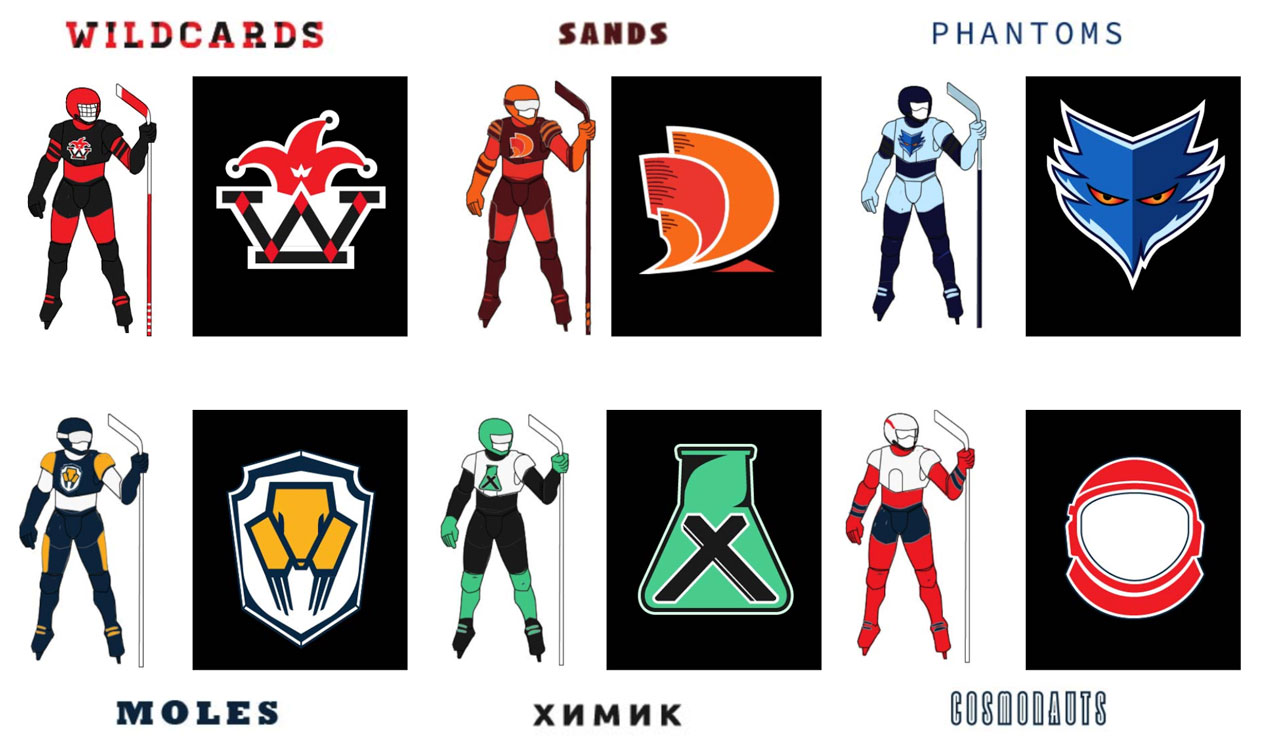
Exhibition teams - Wildcards, Sands, Phantoms, Moles, Khimik and the Cosmonauts
The teams are made up of pilot players from across the settlement, but are all based in either Noviymir, Korolev, or Mareotis. These are the locations ISMO has prototype rink facilities, so most players have temporarily relocated to participate in the unique opportunity.
The first round exhibition schedule begins in 2 weeks on Mina the 21st. Corresponding to this, tour groups have started selling vacation packages in hopes of attracting early adopters and supporters to the ice-towns by offering first-hand inclusive experiences. Packages include skate lessons with players, viewing access to afternoon practise sessions, and tickets to the 'doubleheader' games played on Saturni and Solis.
First round Exhibition Games, Mina 21 & 22:
- PHANTOMS vs. COSMONAUTS - Played at Mareotis
- MOLES vs. KHIMIK - Played at Noviymir
- SANDS vs WILDCARDS - Played at Korolev
For those who are curious but unable to make the trip to the northern settlements, virtual broadcasts will, unfortunately, not be available.
"We are intentionally keeping these games exclusive and close to our chests at this stage," said Fredrick Seulovik, President of ISMO. "This is a dynamic process for us and we'll see where these exhibition games take us. Broadcasts will be coming soon."
With a mission to foster Earth-style 'winter' sporting events, in addition to Martian Ice Hockey, ISMO is expected to reveal a number individual and team oriented experimental games. Rumours indicate that courses have been carved into retired mining facilities that could conceivably host a variety of 'downhill' competitions.
Turning our cold climate into some kind of positive for sports may have its own challenges, but with the ongoing set-backs in our global-warming initiatives (most recently with delays in the Magnetic Dipole Field projects), Mars isn't likely to get warmer anytime soon.

Wizards on Ice
With anticipation for ISMO's upcoming hockey exhibition, we've found 3 behind-the-scenes heroes that are solving problems to make ice sports possible. If Martian hockey takes off, it will be off the backs of innovators like these.
Pisces 28, 2078, m249
Thanks to MAFL, many people are familiar with Amanda Jacobsen. Not for her engineering achievements in San Olympus or the program she runs at the University's engineering faculty, but for her contributions to Martian Aero Football League. Indeed, her popularity has been the result of designing the actual ball.
With anticipation for ISMO's upcoming hockey exhibition, we've found 3 behind-the-scenes heroes that are solving problems to make ice sports possible. If Martian hockey takes off, it will be off the backs of innovators like these.

From left to right: Dr. Elisna Katrine, Byrono Mon-Omar and Lancer Quan.
The Game Designer
Lancer Quan has been on Mars for 5 years, originally contracted for a class 1 technical position with MIIRA Undertech in 2072. His programming skills were essential for updating many of the old AI systems responsible for keeping colony infrastructure at Marineris running.
After finishing his 2 year contract, Quan didn't return to Earth.
"There was just too much work to do," he said in a virtual interview, "There are a lot of old robots and many facilities up here still build new robots on old specs, so Mars is unique in how autonomous units need to be refurbished."
It was after a chance meeting with Fredrick Seulovik, now founder of Ice Sports Mars Org (ISMO), that Quan became involved in the ice hockey project.
"I needed a way to design the sport, to simulate different variations to make it our own," recalled Seulovik, "We couldn't do it in real life, so naturally, we expected to experiment virtually. The problem was finding resources to do this kind of work because everyone on Mars tends to be locked into exclusive contracts. Not only did Lancer have the technical skills, but he actual knew hockey!"
It was the kind project Quan never knew he was after.
"Yes, I played hockey back home," Quan said, "It's was an amazing opportunity to be part of a sport I love, but used to suck at."
In a matter of weeks, his programs were generating and simulating millions of rink variations, rules, team combinations and emulating player skill levels. Seulovik found the funding he needed to form ISMO, all based off of Quan's work.
"I really wish I could take credit for the halfpipe-style rink design," Quan says, "But reality is, it was all the machine."
The Protector
Byrono Mon-Omar is an engineer in the Exo-Equipment division at Chariton Labs. Many of his components are used in industrial EV suits as well as MAFL equipment.
"When I was asked to design sporting equipment for ice hockey," he explained, "I didn't think it would work the way they thought. It wasn't until after a visit to Korolev and actually skating, I became excited about what we could do with a game on Mars."
Mon-Omar was tasked with solving two problems: 1) making streamlined protective equipment with inexpensive locally available materials and 2) reducing risks of blade injury from skates.

Early Prototype equipment based on Mon-Omar's design templates.
"I came up with a set of templates so that when gear is manufactured from different machines and different producers, it meets the specified tolerances for performance and safety."
If you ever find yourself in the unfortunate scenario of getting a skate in the face, Mon-Omar is the person you will thank for the smart-blade that automatically encases itself in milli-seconds upon imminent collisions.
Mon-Omar's contribution goes beyond safety too. When you get a load of the retractable shielding and auto-inflatable padding, even if you've never heard of the sport, you'll have the sudden urge to become a goaltender.
The Dream Maker
Training someone to be an elite athletic performer doesn't happen overnight... or does it?
Traditionally, athlete's train from childhood to specialized in a single sport. They invest tens of thousands of hours to become proficient (not necessarily even competitive). Though every Martians tends to be fit because it is an ingrained necessity and part of our way of life, fitness does not equate to excelling at any particular sport. And even for those that grew up playing Hoopz, Jamtrunkle, or Dodgebat at school, a new sports that involves skating on ice and propelling yourself into the air demands a lot master.
"No one wants to wait a generation for pro sports to happen," Evgeni Stolbova, VP of Skill Development at ISMO, explains, "So we are trying to do both things in parallel - fast track players to competency and teach the youth to play our sport."
Dr. Elisna Katrine might very well be ISMO's secret weapon. Katrine is an expert at dream induction. The technique is a proven and well documented process that has been used for treatment for decades, however it is controversial because it only works for roughly 25% of the population. For this reason, it has never been widely adopted.
The good news for Stolbova? He only needs a a small number of players capable of performing on ice. So the chance at accelerating 25% of his talent pool is a whole lot better than nothing.

"It isn't very much like dreaming at all," said Anna Fedin, one of the candidate pilot players on team Cosmonaut, "Your body shakes as it responds to the stimulus. It was quite an unsettling experience at first, but I can actually sleep through the sessions now."
The process cannot make someone exceed their natural ability, nor does it replace the need for actual physical conditioning. It simply accelerates development of motor skills. According to Dr. Katrine, however, there are drawbacks. The process can result in conflict with real-world training and experiences, so determining when to ramp down treatment is critical.
In the case of ISMO, the hope is this will bring the pilot players to an adequate level where the gameplay is entertaining to watch. With exhibition games slated to begin next month by mid-Mina, the pressure is on.
Dream induction is prohibited in the MAFL. The organization prides itself as fostering 'natural' abilities.
To that, Stolbova responds, "That's fine, but not everyone is born with EV suites and boost thrusters."

Martian Hockey Promises Thrills, But Not Without Problems
The launch of a hockey league on Mars has sparked a wave of optimism, with council leaders celebrating "a new era in Martian sport." The highly anticipated series of exhibition games have been billed as proof that this maturing network of colonies is quickly amassing all the comforts of Earth.
The one hitch, though, is no one can skate.
Pisces 13, 2078, m249

Ice Sport Mars Organization presented their new rinks near Noviymir, Mareotis, and Korolev.
The launch of a hockey league on Mars has sparked a wave of optimism, with council leaders celebrating "a new era in Martian sport." The highly anticipated series of exhibition games have been billed as proof that this maturing network of colonies is quickly amassing all the comforts of Earth.
The one hitch, though, is no one can skate.
In a glitzy, live-streamed press conference yesterday, founders behind the burgeoning hockey league — calling themselves the Ice Sport Mars Organization (ISMO) — promised a faster, more extreme version of the original.
Less encumbered by gravity, top speeds will dwarf even the most elite players on Earth, ISMO claims. The puck is twice the size. Goalies won’t be confined to the net, with retractable pads so they can better join the action. Defenders are also fitted with pads for advanced shot blocking. And, most surprisingly, there won't be traditional boards. Instead the new arenas, built in subterranean ice mines, will look like halfpipes. The ice surfaces will be sunken into the ground, with ramped edges that players can skate up along vertical walls and even propel themselves into the air.
“Our guys are going to be like acrobats,” ISMO president Fredrick Seulovik said. “They can get unbelievable air. They’ll be flipping and spinning overtop of each other.”
But that wasn't the case at a recent practice scrimmage. This reporter was granted an exclusive preview of the game and it was, well, underwhelming.
Players toppled over each other rather than flipping or spinning. Those who managed to stay on their feet were unable to effectively stop, hitting the ramped edges and catapulting themselves into the air, flailing. A goalie, desperate to return to her crease after joining in a rush to the opponent’s end, ungracefully crashed into her net.
There were two minor injuries and four equipment malfunctions in the span of the 45 minutes of ice time.
“I don’t know if I can take this much longer,” one player muttered to another as they made their way to a makeshift locker room, which was really a heated tent beside the enclosed rink.
Of the players I spoke with, none have ever skated before ISMO started training camps three months ago — except a few who played in pick-up games organized as a morale-booster for ice miners at a facility outside Korolev over the past year.

Defenseman Martin Bartschi spent ample time on the ice, horizontally.
“Listen, it’ll get better,” said Evgeni Stolbova, the ISMO’s demoralized vice-president of skills development.
He should hope so.
Investors, buoyed by the recent success of the Martian Aero Football League, sunk millions into leasing space in three ice mines near Novymir and two satellite settlements. It was a clever plan, avoiding the costly process of ice-making since the underground mines already have vast sheets of ice available. But it took some maneuvering to convert the mines into usable arenas. The ice can’t be too cold or the skate blades won’t sink in. So ISMO installed climate control rinks to heat the cavernous environment from -125 C to around -3 C.
For any chance at building broader reach, ISMO will have to expand in to markets much larger than Mareotis Fossae and Korolev. The question is, will anyone be interested in hockey outside the predominantly Scandinavian and Russian cultural centres?
Talks are underway to build arenas in Europa and Marineris. Those two major cities, however, do not have adequate ice pockets nearby — forcing ISMO to build a facility capable of housing a rink rather than use a pre-existing ice surface.
But the organization appears content to play the long game. They've insisted this isn't professional sport yet, only an attempt to build interest and new talent. And it appears to be working. Enrolment in their Ice Sport Academy is already full in all 3 settlements, with participants coming from as far as Wendland and Huacheng.
“This is a chance,” ISMO president Seulovik said, “to not be bored.”
Let’s hope she’s right.

Ice-miners have started a beer league 200 metres below surface
Engineers mining for water outside Novyimir have found a way to skate on underground ice deposits — a fluke development that has led to the first-known organized hockey league on Mars, according to reports out of the secretive settlement.
Verneris, Dhanus 20, 249

Engineers mining for water outside Novyimir have found a way to skate on underground ice deposits — a fluke development that has led to the first-known organized hockey league on Mars, according to reports out of the secretive settlement.
A migrant contractor who just returned from an assignment at one of the remote KMH mining facilities tells us that workers in the glacier-rich region of the Ismenius Lacus quadrangle are playing a rudimentary version of hockey, competing with other teams from nearby ice mines.
“They’re using an awful lot of resources to make it happen,” said the contractor, who did not want to be named for fear of reprisals from the mine operator. “I don’t think they want people to know about it.”
Excavators around Novyimir have carved out swaths of rock and dirt to access the rich ice deposits dozens of metres beneath the surface — creating massive underground caverns roughly 200 metres deep with floors of ice that run for kilometres.
“We were working 24-hour shifts, right?” the contractor said. “And we’re just slipping around on this stuff all day until someone finally told the foreman, ‘You think you could get us some skates?’”
“It seemed like a shame not to skate on all that ice before we processed it.”
Management at the mine apparently took the suggestion seriously. Within a month, the KMH Ministry of Subterranean Extraction developed a method of outfitting cavern personnel with skates. The move was an attempt at “increasingly workflow and reducing accidents,” according to a memo the contractor smuggled from a work site.
At first, the skates didn't work. For a skate to get traction on ice, it needs to melt the surface enough for the ice to hug the blade. The average temperature in the mine, roughly -125C, was simply too cold for the ice to melt. To mitigate the issue, KMH implemented environment controls in all six ice mines near the Korolev settlement, bringing the temperature at ice level to an average of -3C — similar to a hockey rink.
“They thought we were all going to get from A to B faster and easier,” the contractor said. “But really, it was a mess. People zipping around, clumsy, with heavy machinery around? Someone was gonna die.”
“The guys who came up with the idea, they were desperate. The Russians who run things over there, they don’t like wasting money on mistakes. So figured they could salvage the whole project by turning it into some Employee Fitness and Morale program.”
So far, it seems to have worked. KMH medical logs show a drastic reduction in cases of muscular deterioration among mine personnel in the Korolev district. And the contractor says the deputy minister of natural resources attended a game last month.
“A lot of the players are old KHL guys,” the contractor said. “It's not bad hockey. I think some higher ups have even slipped in an order for real, composite sticks on the next barge shipment from Russia."
But the move is not without critics. Eriika Yang, who runs three ice-mining operations in Tiangong, called the program "ghastly and moronic."
“I don’t get it,” she said. “Why would you waste energy heating an entire cavern, just to skate on it?”